From my delayed viewing of the first Democratic candidates debate on MSNBC...
Hillary Clinton: Worst response was the first part of the debate, on Iraq. Repeated the insufferable line about how we gave Iraqis the "opportunity for freedom." Her health care response started interestingly, as she emphasized the middle class that already has insurance but is struggling to afford premiums, then she went on to say something along the lines of getting the most out of our current system before we pay any more for something else. What does she mean by that? Her website has no policy, so I don't know! She did take the opportunity to redirect a possible criticism of Obama (opportunity handed by the moderator) into Bush criticism.
Barack Obama: Barack was, as usual, pretty generic. His health-care response was straight out of The Audacity of Hope. He took a few opportunities to emphasize the need for a national movement. Three candidates had a question on the abortion decision, and all three took different angles; Obama emphasized women's choices in concert with families, doctors and clergy (he didn't miss the chance to throw that in). My favorite answer of his was actually to the question "what is your biggest mistake of the last four years?". He was the only one to answer nongenerically, saying that he should not have left the Senate during the Schiavo case but should have stayed to fight for families' privacy.
John Edwards: I was unimpressed with Edwards on Iraq (he seemed smug about his position) or on his wealth. His SCOTUS response was to emphasize the need for a Democrat to appoint the next justices--predictably for a trial lawyer. He did win points for having the most specific health-care response.
Bill Richardson: I wasn't actually aware of some of Richardson's positions before the debate. He was good on Iraq--the most specific and committed of any of them. Said if he were president he would withdraw everyone before 2007 is out. On health care, said that there's a lot of waste and that it should be cut, and no raising taxes, but no specifics. Top three priorities: out of Iraq, energy independence, climate change.
Joe Biden: Biden wins points with me for saying "If we want the best students in the world, we need the best teachers in the world." Otherwise, his response on Iraq seemed to be a mandate to the Iraqis! Good responses on gun control, the NAACP and South Carolina, and on his mistake ("overestimating the confidence and underestimating the arrogance of this administration"). When asked if he'd be able to be president despite some of his notorious errant comments, stated, "Yes."
Chris Dodd: I don't think he said too much to stand out. He put a lot of emphasis on his experience and political background, which isn't necessarily the way to go. Good responses on why welfare recipients should not have drug tests, and on justifying civil unions by "thinking if it was your own kids" (though I disagree with his opposition to gay marriage).
Dennis Kucinich: Alternated between awkward (which he always is), unrealistic (international peacekeepers in Iraq!), and somewhat decently principled (in response to abortion, America needs a "culture of life" that includes a lot more than just abortion). But hey, we should support his campaign because it "comes from the heart."
Mike Gravel: Who is this guy? He tried to grab attention by criticizing Iraq and the other candidates over, and over, and over again, hijacking a question about nuclear energy and turning it into terrorism and why the war was wrong. Rambled about Congressional strategy to pass a law to end the war in Iraq. Tried to engage Barack in an argument (along with Kucinich) while Hillary stood in the middle rather awkwardly. Says all the "top-tier candidates" "scare [him]" and seems to imply they will support an Iran invasion. He might get a little attention, but not sure what he'll get out of that...
Overall: No huge winners or losers; this was really more of a warmup. Richardson is a rational guy with a couple policy stances that seem a little off with the base. Obama, Clinton and Edwards said nothing new. Biden is probably the biggest riser.
Friday, April 27, 2007

Thursday, April 26, 2007
Computer problems lead to book use!
I've meant to comment on a number of pending issues, but instead I've had a lot of computer problems. My computer contracted some sort of bug that made the CPU run very slowly and wasn't picked up by any spyware/malware programs, so I ended up having to do a system recovery. Now I can't access my old documents through some sort of Windows quirk--they're sitting there, but I can't get into the directory!
While dealing with that, I've been able to catch up on some reading. I read large parts of Philip Short's Mao: A Life the other night, a book which I started a few months ago, and I've been reading parts of Chernow's Alexander Hamilton as well. Both appear to be excellent biographies of memorable figures in world history. Short describes Mao as a master politican during the years of the PRC, extremely sensitive to criticism, especially as he got older, but also extremely concerned with his legacy--a legacy which he ended up failing to protect (to the benefit of the Chinese). Hamilton, a remarkable figure, emerged from an impoverished background on the island of Nevis, and took advantage of the unique times he was in to be one of the most profound shapers of the United States and our current system. I'm looking forward now to completing both books in order. I also finished Doris Kearns Goodwin's Team of Rivals a couple of weeks ago; I will post some sort of review as soon as I catch up with life, and Windows XP.
While dealing with that, I've been able to catch up on some reading. I read large parts of Philip Short's Mao: A Life the other night, a book which I started a few months ago, and I've been reading parts of Chernow's Alexander Hamilton as well. Both appear to be excellent biographies of memorable figures in world history. Short describes Mao as a master politican during the years of the PRC, extremely sensitive to criticism, especially as he got older, but also extremely concerned with his legacy--a legacy which he ended up failing to protect (to the benefit of the Chinese). Hamilton, a remarkable figure, emerged from an impoverished background on the island of Nevis, and took advantage of the unique times he was in to be one of the most profound shapers of the United States and our current system. I'm looking forward now to completing both books in order. I also finished Doris Kearns Goodwin's Team of Rivals a couple of weeks ago; I will post some sort of review as soon as I catch up with life, and Windows XP.
Sunday, April 22, 2007
Reckling Park grandstand
As promised, a few more pictures of Reckling Park on the Rice University campus. Today the Owls defeated UCF 8-0, sweeping the Golden Knights in the weekend series. Rice is now 13-2 in conference play and 33-11 overall.

A look at the grandstand from right field.
 The main entrance behind home plate, looking out.
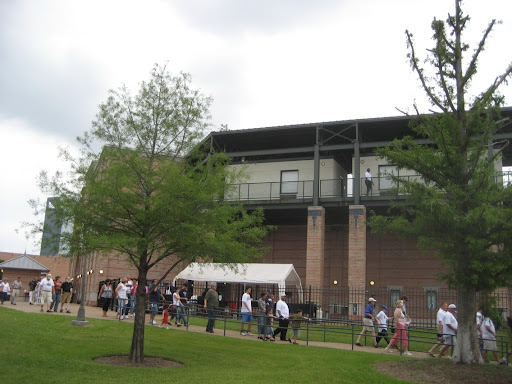 Home plate entrance is on the left; this is the exterior down the first-base line.

A look at the grandstand from right field.
 The main entrance behind home plate, looking out.Home plate entrance is on the left; this is the exterior down the first-base line.
France's first round: lack of surprise is a surprise
Looks like the polls were more accurate than anyone wanted to admit. With about 64% of votes counted, Nicolas Sarkozy of the UMP has taken over 30%, with Ségolène Royal, the Socialist candidate, taking just under 25%. François Bayrou of the Christian-democratic UDF is around 18% and perennial nationalist candidate Jean-Marie Le Pen has 11%.
Extremely high turnout, probably around 85%, was advantageous to the main candidates. It seems many, many people turned out because they did not want to see a spoiler candidate (i.e., Le Pen) in the second round. And those who voted Le Pen last time as a protest this time either voted for a main candidate or for one of the other candidates. The polls did not hide any Le Pen votes as Sarkozy votes this time around.
What does this mean for the second round? Well, Sarkozy has made a very strong showing. He needs to net some of Bayrou's following while also managing to convince those who voted for Le Pen to come around to him--i.e. appeal to the center and to the right. Royal has a tougher time, as she will probably take the vote going to the smaller leftist candidates, but absolutely needs a strong majority of those who voted for Bayrou. This is possible, if she can continue to frame Sarkozy as too extreme and liberalizing.
All that said, the polls going into today were showing a very narrow (2-4 point) Sarkozy lead in a hypothetical runoff. Still, I give Sarkozy a 60-40 shot at this point.
Oh yeah... how did I do? Well, I accurately stated that the two major candidates would make the runoff, but definitely underestimated their percentages, and overestimated Le Pen. Everyone, including me, was looking for a surprise; but the only surprise was the turnout, not the percentages.
Extremely high turnout, probably around 85%, was advantageous to the main candidates. It seems many, many people turned out because they did not want to see a spoiler candidate (i.e., Le Pen) in the second round. And those who voted Le Pen last time as a protest this time either voted for a main candidate or for one of the other candidates. The polls did not hide any Le Pen votes as Sarkozy votes this time around.
What does this mean for the second round? Well, Sarkozy has made a very strong showing. He needs to net some of Bayrou's following while also managing to convince those who voted for Le Pen to come around to him--i.e. appeal to the center and to the right. Royal has a tougher time, as she will probably take the vote going to the smaller leftist candidates, but absolutely needs a strong majority of those who voted for Bayrou. This is possible, if she can continue to frame Sarkozy as too extreme and liberalizing.
All that said, the polls going into today were showing a very narrow (2-4 point) Sarkozy lead in a hypothetical runoff. Still, I give Sarkozy a 60-40 shot at this point.
Oh yeah... how did I do? Well, I accurately stated that the two major candidates would make the runoff, but definitely underestimated their percentages, and overestimated Le Pen. Everyone, including me, was looking for a surprise; but the only surprise was the turnout, not the percentages.
Interesting facebook stats...
are available now, thanks to the newest (yes, another) design of facebook. Looking at the networks for U.S. News's Top 28 national universities (why the top 28? Because that's as far as I got), some interesting notes:
- The #1 interest, at every school, is the suitably generic "Music." #2 is almost always "Reading" (understandable exceptions: "Skiing" at Dartmouth; "Movies" at USC).
- As for that music, 25 out of 28 schools had Coldplay #1 in mentions. The Beatles, Radiohead, and Jack Johnson were the most common #2 and #3; some combination of those two popped up almost everywhere.
- In movies, the two most commonly cited movies were Fight Club (#1 at a majority) and Wedding Crashers. As you move down the rankings, Wedding Crashers becomes more prevalent. The only school with a different #1 was Harvard (Love Actually).
- TV provided an interesting pattern. Almost everywhere, the top program was "Family Guy" or "Grey's Anatomy." A top predictor of which was #1 was provided by whether there were more self-identified male or female students. "Family Guy" schools averaged +5 percent male. "Grey's" schools averaged +3 percent female. (One school--Princeton--had "24," then "Family Guy," then "Grey's"; it is +7% male).
- And for the readers, "Harry Potter" as a generic category was #1 at all schools. #2 was split between several books, the most common being The Great Gatsby and The Catcher in the Rye, with no discernable pattern showing.
- As for self-identification of sex, the top male school was MIT (44%) and the top female school UNC (46%).
- Students at the very top schools tended to be more discreet about their political leanings and relationship status. At the top 10 schools, an average of 57 percent revealed no political affiliation; at the remaining 18, the average was 51 percent. The gap was even more profound for relationship status (52 percent versus 43 percent).
- As for that relationship status, 40-45 percent of those divulging tended to say "single," and at all schools, 32-36 percent of those responding said "in a relationship" (of course, this counts facebook-only relationships). At most of the 28 universities, from 6 to 8 percent of all in-network people stated "married," and from 2-4 percent said "engaged." "It's complicated" almost always netted 2 percent of the network and "in an open relationship" (almost always fake) 1 percent.
- The top school for singles, relative to those responding, was UCLA (52% single), with USC (51%) a close second. The lowest proportion of singles was Harvard (37%).
- Finally, as for political affiliation, on a scale of 5 points for "very liberal" and 1 for "very conservative," and excluding "libertarian," "apathetic," and "other," the top 28 broke down as follows:
- Most liberal: UC-Berkeley (3.85), Yale (3.82), Brown (3.80), Columbia (3.77)
- Most conservative: Notre Dame (3.02), Vanderbilt (3.11), UNC (3.16), UVA (3.40).
- Note for Huskies: UW (not one of the 28 included) comes in at 3.48, towards the middle of the ranked schools.
Saturday, April 21, 2007
Reform in Ontario?
Exciting developments in Ontario, where the Citizens' Assembly, a randomly chosen body of citizens from each of the 103 current provincial ridings, decided to overwhelmingly endorse reform to an MMP system. The system the Citizens' Assembly provides would combine 90 ridings with 39 province-wide closed-list seats--i.e. minimal change while providing proportional outcomes. It is already facing the predictable opposition from the main parties and establishment, and must clear a 60 percent threshold to pass, but it certainly deserves support. See democraticSPACE for more.
The NDP has come out in support; BC and PEI have already rejected reform, though BC seems likely to move to STV (having voted 58 percent in favor last time, Note: the approval threshold was 60 percent) in 2009. New Brunswick is currently studying the issue.
Correction: New Brunswick is actually done studying the issue; the Commission on Legislative Democracy proposed an MMP system with 36 riding and 20 closed-list seats in 4 regions (also recommending that the new system prohibit riding candidates from running on a list, and vice versa). However, it is unclear if the new Liberal government will call the referendum, which was promised by the previous PC premier, Bernard Lord. This would be sadly appropriate, as the Liberals just won the 2006 election despite losing to the Conservatives by 1,400 votes.
The NDP has come out in support; BC and PEI have already rejected reform, though BC seems likely to move to STV (having voted 58 percent in favor last time, Note: the approval threshold was 60 percent) in 2009. New Brunswick is currently studying the issue.
Correction: New Brunswick is actually done studying the issue; the Commission on Legislative Democracy proposed an MMP system with 36 riding and 20 closed-list seats in 4 regions (also recommending that the new system prohibit riding candidates from running on a list, and vice versa). However, it is unclear if the new Liberal government will call the referendum, which was promised by the previous PC premier, Bernard Lord. This would be sadly appropriate, as the Liberals just won the 2006 election despite losing to the Conservatives by 1,400 votes.
A big weekend for elections
It's a big weekend for elections, with Nigeria at the polls now and France voting tomorrow. In Nigeria, I would predict a ruling-party win, violence, and denunciations by the opposition--in other words, I am taking the easy guess. In France, I predict that despite all the talk of Bayrou or Le Pen possibly spoiling, that Royal and Sarkozy will go to the second round; however, I think that Royal will be substantially closer to Sarkozy than the polls have stated, and that both will be around 22-23 percent with Bayrou and Le Pen no more than 4 points behind.
In other election news, Manitoba Premier Gary Doer has called elections for May 22.
In other election news, Manitoba Premier Gary Doer has called elections for May 22.
Photos of Reckling Park
It's more expensive to see a game at Rice's Reckling Park--$7 in the bleachers down the lines and $10 in the upper reserved--but the park has more of an atmosphere than UH's Cougar Field. Renovated and reopened in 2000, the park maintains somewhat of an older atmosphere through its brick exterior and concourse building (I'll take photos of that this weekend). However, it is comfortable, has great sightlines and has a nice modern press box behind the stands. I enjoyed the atmosphere--as with many college baseball games, many in the crowd knew each other, and I saw at least four or five other people keeping score near my section!
 Skyline of the Med Center part of Houston.
 Down the home-team side.
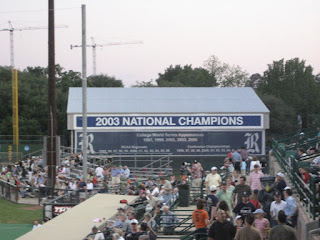 Rice's playoff appearances--the program has been competitive on a consistent basis since the mid-'90s.
 Skyline of the Med Center part of Houston.
 Down the home-team side.
 Rice's playoff appearances--the program has been competitive on a consistent basis since the mid-'90s.
Friday, April 13, 2007
Am I the only one who'd never heard of Don Imus?
Don Imus no longer has a job due to his comments, which seem to have enraged a large portion of the blogs that I read on a regular basis.
I generally agree with them, but I have little to add, because to be honest I'd never heard of the guy before this whole thing. Is Don Imus more well known on the East Coast? Or am I just not in his demographic? Or is it neither, and I'm just out of the loop? I feel like everyone else knows more than me about this one... at any rate, nothing out of the media really surprises me anymore, and I'm more interested in the linguistics of the issue than the story at hand.
I generally agree with them, but I have little to add, because to be honest I'd never heard of the guy before this whole thing. Is Don Imus more well known on the East Coast? Or am I just not in his demographic? Or is it neither, and I'm just out of the loop? I feel like everyone else knows more than me about this one... at any rate, nothing out of the media really surprises me anymore, and I'm more interested in the linguistics of the issue than the story at hand.
Franken posts some good numbers
AP reports that Al Franken has raised almost as much campaign cash as Norm Coleman so far despite not even starting until February. Franken has received big donations from figures such as Tom Hanks, Larry David, Lorne Michaels, and Kevin Bacon.
Quote of the night: "Franken has held two fundraisers in California this year -- one in Los Angeles and one in California, said his spokesman, Andy Barr."
Quote of the night: "Franken has held two fundraisers in California this year -- one in Los Angeles and one in California, said his spokesman, Andy Barr."
Subscribe to:
Posts (Atom)
