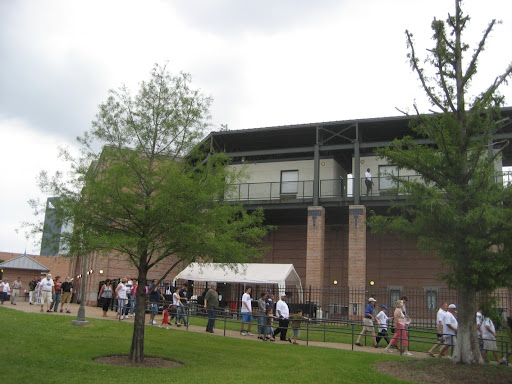
A look at the grandstand from right field.
Sunday, April 22, 2007
Reckling Park grandstand
As promised, a few more pictures of Reckling Park on the Rice University campus. Today the Owls defeated UCF 8-0, sweeping the Golden Knights in the weekend series. Rice is now 13-2 in conference play and 33-11 overall.

A look at the grandstand from right field.
The main entrance behind home plate, looking out.
Home plate entrance is on the left; this is the exterior down the first-base line.
A look at the grandstand from right field.
France's first round: lack of surprise is a surprise
Looks like the polls were more accurate than anyone wanted to admit. With about 64% of votes counted, Nicolas Sarkozy of the UMP has taken over 30%, with Ségolène Royal, the Socialist candidate, taking just under 25%. François Bayrou of the Christian-democratic UDF is around 18% and perennial nationalist candidate Jean-Marie Le Pen has 11%.
Extremely high turnout, probably around 85%, was advantageous to the main candidates. It seems many, many people turned out because they did not want to see a spoiler candidate (i.e., Le Pen) in the second round. And those who voted Le Pen last time as a protest this time either voted for a main candidate or for one of the other candidates. The polls did not hide any Le Pen votes as Sarkozy votes this time around.
What does this mean for the second round? Well, Sarkozy has made a very strong showing. He needs to net some of Bayrou's following while also managing to convince those who voted for Le Pen to come around to him--i.e. appeal to the center and to the right. Royal has a tougher time, as she will probably take the vote going to the smaller leftist candidates, but absolutely needs a strong majority of those who voted for Bayrou. This is possible, if she can continue to frame Sarkozy as too extreme and liberalizing.
All that said, the polls going into today were showing a very narrow (2-4 point) Sarkozy lead in a hypothetical runoff. Still, I give Sarkozy a 60-40 shot at this point.
Oh yeah... how did I do? Well, I accurately stated that the two major candidates would make the runoff, but definitely underestimated their percentages, and overestimated Le Pen. Everyone, including me, was looking for a surprise; but the only surprise was the turnout, not the percentages.
Interesting facebook stats...
are available now, thanks to the newest (yes, another) design of facebook. Looking at the networks for U.S. News's Top 28 national universities (why the top 28? Because that's as far as I got), some interesting notes:
- The #1 interest, at every school, is the suitably generic "Music." #2 is almost always "Reading" (understandable exceptions: "Skiing" at Dartmouth; "Movies" at USC).
- As for that music, 25 out of 28 schools had Coldplay #1 in mentions. The Beatles, Radiohead, and Jack Johnson were the most common #2 and #3; some combination of those two popped up almost everywhere.
- In movies, the two most commonly cited movies were Fight Club (#1 at a majority) and Wedding Crashers. As you move down the rankings, Wedding Crashers becomes more prevalent. The only school with a different #1 was Harvard (Love Actually).
- TV provided an interesting pattern. Almost everywhere, the top program was "Family Guy" or "Grey's Anatomy." A top predictor of which was #1 was provided by whether there were more self-identified male or female students. "Family Guy" schools averaged +5 percent male. "Grey's" schools averaged +3 percent female. (One school--Princeton--had "24," then "Family Guy," then "Grey's"; it is +7% male).
- And for the readers, "Harry Potter" as a generic category was #1 at all schools. #2 was split between several books, the most common being The Great Gatsby and The Catcher in the Rye, with no discernable pattern showing.
- As for self-identification of sex, the top male school was MIT (44%) and the top female school UNC (46%).
- Students at the very top schools tended to be more discreet about their political leanings and relationship status. At the top 10 schools, an average of 57 percent revealed no political affiliation; at the remaining 18, the average was 51 percent. The gap was even more profound for relationship status (52 percent versus 43 percent).
- As for that relationship status, 40-45 percent of those divulging tended to say "single," and at all schools, 32-36 percent of those responding said "in a relationship" (of course, this counts facebook-only relationships). At most of the 28 universities, from 6 to 8 percent of all in-network people stated "married," and from 2-4 percent said "engaged." "It's complicated" almost always netted 2 percent of the network and "in an open relationship" (almost always fake) 1 percent.
- The top school for singles, relative to those responding, was UCLA (52% single), with USC (51%) a close second. The lowest proportion of singles was Harvard (37%).
- Finally, as for political affiliation, on a scale of 5 points for "very liberal" and 1 for "very conservative," and excluding "libertarian," "apathetic," and "other," the top 28 broke down as follows:
- Most liberal: UC-Berkeley (3.85), Yale (3.82), Brown (3.80), Columbia (3.77)
- Most conservative: Notre Dame (3.02), Vanderbilt (3.11), UNC (3.16), UVA (3.40).
- Note for Huskies: UW (not one of the 28 included) comes in at 3.48, towards the middle of the ranked schools.
Saturday, April 21, 2007
Reform in Ontario?
Exciting developments in Ontario, where the Citizens' Assembly, a randomly chosen body of citizens from each of the 103 current provincial ridings, decided to overwhelmingly endorse reform to an MMP system. The system the Citizens' Assembly provides would combine 90 ridings with 39 province-wide closed-list seats--i.e. minimal change while providing proportional outcomes. It is already facing the predictable opposition from the main parties and establishment, and must clear a 60 percent threshold to pass, but it certainly deserves support. See democraticSPACE for more.
The NDP has come out in support; BC and PEI have already rejected reform, though BC seems likely to move to STV (having voted 58 percent in favor last time, Note: the approval threshold was 60 percent) in 2009. New Brunswick is currently studying the issue.
Correction: New Brunswick is actually done studying the issue; the Commission on Legislative Democracy proposed an MMP system with 36 riding and 20 closed-list seats in 4 regions (also recommending that the new system prohibit riding candidates from running on a list, and vice versa). However, it is unclear if the new Liberal government will call the referendum, which was promised by the previous PC premier, Bernard Lord. This would be sadly appropriate, as the Liberals just won the 2006 election despite losing to the Conservatives by 1,400 votes.
A big weekend for elections
It's a big weekend for elections, with Nigeria at the polls now and France voting tomorrow. In Nigeria, I would predict a ruling-party win, violence, and denunciations by the opposition--in other words, I am taking the easy guess. In France, I predict that despite all the talk of Bayrou or Le Pen possibly spoiling, that Royal and Sarkozy will go to the second round; however, I think that Royal will be substantially closer to Sarkozy than the polls have stated, and that both will be around 22-23 percent with Bayrou and Le Pen no more than 4 points behind.
In other election news, Manitoba Premier Gary Doer has called elections for May 22.
Photos of Reckling Park
It's more expensive to see a game at Rice's Reckling Park--$7 in the bleachers down the lines and $10 in the upper reserved--but the park has more of an atmosphere than UH's Cougar Field. Renovated and reopened in 2000, the park maintains somewhat of an older atmosphere through its brick exterior and concourse building (I'll take photos of that this weekend). However, it is comfortable, has great sightlines and has a nice modern press box behind the stands. I enjoyed the atmosphere--as with many college baseball games, many in the crowd knew each other, and I saw at least four or five other people keeping score near my section!
Skyline of the Med Center part of Houston.
Down the home-team side.
Rice's playoff appearances--the program has been competitive on a consistent basis since the mid-'90s.
Friday, April 13, 2007
Am I the only one who'd never heard of Don Imus?
Don Imus no longer has a job due to his comments, which seem to have enraged a large portion of the blogs that I read on a regular basis.
I generally agree with them, but I have little to add, because to be honest I'd never heard of the guy before this whole thing. Is Don Imus more well known on the East Coast? Or am I just not in his demographic? Or is it neither, and I'm just out of the loop? I feel like everyone else knows more than me about this one... at any rate, nothing out of the media really surprises me anymore, and I'm more interested in the linguistics of the issue than the story at hand.
Franken posts some good numbers
AP reports that Al Franken has raised almost as much campaign cash as Norm Coleman so far despite not even starting until February. Franken has received big donations from figures such as Tom Hanks, Larry David, Lorne Michaels, and Kevin Bacon.
Quote of the night: "Franken has held two fundraisers in California this year -- one in Los Angeles and one in California, said his spokesman, Andy Barr."
Monday, April 09, 2007
New Baltic governments
In Finland, after the surprising surge by the conservative National Coalition (Kansallinen Kokoomus) in the March parliamentary elections, KOK will be incorporated into the new government. If all goes well in upcoming talks, the government will be formed by Finnish Center (Suomen Keskusta), the party of PM Matti Vanhanen; the Kokoomus; and two smaller parties, the Swedish People's Party (Svenska folkpartiet), which is always in government, and the Greens (Vihreä Liitto). Helsingin Sanomat provides more detail on the coalition negotiations.
One might expect that the new government platform will have something to do with lowering some taxes, increasing competitiveness, and perhaps doing something in the direction of a guaranteed minimum income (giving recipients more flexibility). One question HS brings up is what position will be awarded to wildly popular Sauli Niinistö, the 1994-2001 party leader and '06 presidential candidate (who almost defeated incumbent Tarja Halonen and relegated PM Vanhanen to a distant third). Niinistö served as finance minister in both Lipponen SDP-led governments (1995-2003), but that post apparently will go to current party chair Jyrki Katainen. Possiblities include foreign minister or speaker of the Eduskunta. (Apparently, the latter is a fairly prestigious position; the previous holder of the office was ex-PM Lipponen himself).
Governments in Finland tend to be supermajorities so that no small party can hold the coalition "hostage." The last government, KESK+SDP+SFP, met this criteria as Keskusta and SDP together held 108 of the Eduskunta's 200 seats. This time, KESK and KOK together hold 101 seats, a razor-thin majority; SFP holds 9, and the Greens 15, giving the coalition a total of 125 and not allowing either Greens or SFP to hold out on any particular issue.
SDP leader Eero Heinäluoma has criticized the Greens for participating in the government; this really just seems like sour grapes, especially before a platform is out. Hence we will have to see what comes of the negotiations. (Who knows... maybe the notorious Vanhanen's purported liaisons with a Green MP had something to do with it? Don't take my word for it, check out all these links in Finnish I can't read).
Meanwhile, in Estonia
The Center Party (also KESK, since Estonian and Finnish are family members) has been kicked out of government in the new post-election scenario. The new government (already sworn in on 5 April) seems rather awkward at first glance, incorporating the conservative Pro Patria/Res Publica Union and the Social Democrats as well as the free-market Reform Party of PM Andrus Ansip.
I have absolutely no idea what has led to the formation of this government, and the only suggestion I would have is that perhaps the Center Party's reportedly more pro-Russian (perhaps better to say less anti-Russian) stance got it booted from government, along with personal rivalries and the close finish between Center and Reform. This was probably more galling for the Center Party, which had the most seats of any party in the previous coalition; Reform surged ahead of Center to become the largest party in parliament. Hence electoral calculations (rather than policy) may have played a role, though that's pure conjecture.
As far as policy goes, it appears the government will cut the flat tax from 22 to 18 percent. The new government also reiterated its determination to remove the Soviet war memorial from Tallinn.
Update: This blog has a lengthy analysis of the Estonian government formation.
I am not talking about garden implements!
The continuing controversy over broadcaster Don Imus's comments has had a beneficial side effect for me: I can spell a new word! Maybe.
The New York Times reports that Imus's offense was to call the Rutgers women's basketball team "nappy-headed ho's." Now, if we break it down, "ho's" is the plural form, and we come up with the singular form ho' (the apostrophe cannot, of course, be part of a pluralization, unless done incorrectly). This would make sense, since the word omits the following "r" sound of the original ancestor word. However, were the singular to be spelled ho, then ho's is a clear grammatical error.
AP, via ESPN.com, disagrees with NYT, however, using the plural "hos." This form seems to leave open the dangerous possibility of pronouncing the word "hoss," as in "Ol' Hoss."
How, exactly, are these cases decided at a newspaper? Majority vote? Or is the word ho' really in somebody's Style Guide?
Addendum: In no way do I condone the comments Imus made, by the way, but I haven't followed it closely so I have nothing to add to that discussion; there's plenty in the mass media. To me, honestly the more interesting aspect is this linguistic one.
Subscribe to:
Posts (Atom)