Saturday, May 26, 2007

And they say all parties are the same...

Well, maybe. Apparently in April (see El Mundo), the Socialist Party of the Canary Islands (PSC-PSOE) got caught copying the platform of the party Ciutadans (C) of Catalonia. Yes, different parties, from different parts of the country, with pretty much the same platform. It's not just "pretty much the same"... it is the same:

From "125 measures for the first year of a Socialist government: for change in the Canaries" [PDF] (my translation):

We reaffirm the right of the citizens of the Canaries to refer to the Defensor del Pueblo, who is also defender of Canarians; to defend their rights and freedoms when those are threatened by public powers, whether they be autonomic, local or national.

From "100 proposals to improve Catalonia" [PDF] (again, my translation):

We reclaim the right of the citizens of Catalonia to refer to the Defensor del Pueblo, who is also defender of Catalans; to defend their rights and freedoms when those are threatened by public powers, whether they be autonomic, local or national.

The second is the original; the first is the copy. (What, you couldn't tell?). Now, no more comments on how all those politicians are identical!!

This is part of the lead-up to tomorrow's Spanish municipal and autonomic elections--more on those as the results come in.

Monday, May 21, 2007

Farmers Branch: why not STV?

A judge has ruled that the Dallas suburb of Farmers Branch cannot enforce its new ordinance against renting apartments to illegal immigrants. The judgment apparently held that the city created its own way of determining whether or not a resident was legal, a responsibility that belongs only to the federal government.

I would be against this ordinance for a couple of reasons: first, because it seems likely to lead to some harassment of people who are legal, but happen to be Hispanic; second, because if all communities adopt similar ordinances, it probably won't cut the number of illegal immigrants, but it could have a very substantively negative impact on the conditions they and their children live in.

What interests me more, however, was further down in the article:

The federal suit, on behalf of three Latino voters who live in Farmers Branch, claims minorities are underrepresented because of the at-large city council system.

It seeks the creation of single-member districts, in which a city council member is elected to represent a specific section of the city. Both large and small cities with diverse racial makeup use the system, said Rolando Rios, the attorney leading the suit.

Activists say if the method had been in place, at least one Latino candidate would have been elected to the council and could represent the group. All five council members are white men.

This assumes that the only or, at least, primary way to represent a voter is by racially descriptive representation. This may be true on this issue, but as the article notes, all five current members of the council are white men. What about women? What about representation on the basis of nonracial issues?

Instead, the plaintiffs would have the city box itself into a racially charged model of electing its City Council by creating seats "reserved" for Latino voters (much like, of course, the U.S. Congress), at the expense of other forms of representation, and at the expense of "disenfranchising" the minority-majority white population in the "Latino" district.

Why not ask, instead of a district model, for a proportional representation model--in particular, the single transferable vote? STV would maintain the system of citywide representation while representing what voters want to see represented.

This is just, of course, a microcosm of the U.S. system in general: if we just took measures to make things more proportional, there'd be no need for ridiculously gerrymandered districts [warning--PDF] to satisfy someone's exclusive concept of "representation." Then the Texas legislators would never have to go to Oklahoma again!

Sunday, May 06, 2007

Welsh Assembly MMP: not quite proportional

The results from the Welsh Assembly elections are in, with some interesting results:

Labour - 29.6%, 26 seats (43% of seats)
Plaid Cymru - 21.0%, 15 seats (25% of seats)
Conservative - 21.5%, 12 seats (20% of seats)
Lib Dems - 11.7%, 6 seats (10% of seats)
local independent - 1 seat
others - 16.2%, 0 seats

The facts that most jump out are:
(1) Labour won a disproportionately large share of seats, despite the MMP system, and
(2) Plaid placed ahead of the Conservatives despite a slightly smaller regional vote share.

Both of these issues stem from characteristics of the MMP system that Wales (and Scotland) use for elections. The Welsh system has 60 seats, with 40 elected in single-member constituencies and 20 elected from the five regions (four per region) as compensatory list seats. The two features that lead to the outcomes noted above are:
(1) The system does not compensate for overhangs. Every region has 11-13 seats, of which 4 are compensatory and the rest are from single-member constituencies. Taking South Wales West as an example, Labour won all 7 single-member districts (63 percent of the seats already) but took only 36 percent of the PR vote, meaning it deserved only 5 of the 11 seats. In the version of MMP used by Germany or New Zealand, Labour could keep the 7 seats, but an additional 6 seats would be awarded to other parties, increasing the size of the legislature by two. Not so in Wales (or Scotland)--the extra seats are scrapped, meaning fewer seats for the others.
(2) Compensatory seats are only 1/3 of the Assembly. Enlarging compensatory seats to 1/2 of the Assembly, even if overhangs are still not included, would mostly eliminate the problem.


The overhangs described in (1) give Labour five extra seats in the Welsh Assembly. The big loser was the Conservatives. In the regions where Labour took extra seats in constituencies, the Conservatives were generally the party that lost the compensatory seat which was no longer allocated. This happened in North Wales, South Wales West and South Wales East. (The Lib Dems also lost two seats in this way).

If overhangs were incorporated into the electoral system, the results would have been:
Labour - 29.6%, 26 seats (40% of seats)
Conservative - 21.5%, 15 seats (23% of seats)
Plaid Cymru - 21.0%, 15 seats (23% of seats)
Lib Dems - 11.7%, 8 seats (12% of seats)
local independent - 1 seat
others - 16.2%, 0 seats
The Assembly would be enlarged from 60 to 65 seats.

Labour would still enjoy a disproportionate share of seats, but not by quite a large margin.

Wednesday, May 02, 2007

Elections for Turkey

The Constitutional Court made its unfortunate, yet predictable, ruling today, "upholding" the secular system by rejecting democracy. The response of PM Erdogan was the election call. In a previous post I noted how the opposition's argument has little actual merit--the New York Times, too, noted that the decision was more political than legal.

Abdullah Gul is the only clear presidential candidate because he is the candidate of a party that holds very close to 2/3 of the seats (the necessary majority). Note that this is possible because of the antidemocratic 10% threshold for the National Assembly. As a result of this threshold, AK took about 65% of the seats with 34% of the votes in the previous election, as only two parties qualified for parliament. This threshold exists because of the fear of marginal Islamist parties.

While AK obviously is on a much different position in the political spectrum from myself, were I Turkish I would support AKP as the best party to lead the country toward full democracy. In fact it is doubtful whether any other party could accomplish this! In this role AKP has been thrust into a liberalizing position, whatever the natural tendencies of its leaders such as Gul and Erdogan. In order to defend their right to be in the political spectrum, AK figures must reach for legitimation to liberal democratic rights--meaning that the Islamist party is (quite effectively) enacting economic reforms needed for EU membership and supporting all-around political reform and liberalization. Quite unlike some other places.

Well, we will see the electorate's opinion soon enough.

Will Canada have a majority government again?

Referring, of course, to a single-party majority government.

I would argue that the days of single-party majority government are permanently over.

A Conservative majority would require the hold on the West to continue, plus about 2/3 of Ontario and half of Quebec. This is the most likely scenario for a single-party majority but still unlikely due the continued failure of the Conservatives to catch on in Ontario, and the large constituency that simply will never vote Conservative.

A Liberal majority would require a virtual sweep of Ontario, as in '93 or '97, a return in Quebec, and a sweep of the Maritimes. That is to say, all the conditions of the '90s--but the right wing isn't divided anymore. The only alternative would be a Liberal reemergence in the West, which is not on the immediate agenda.

Nobody else will be close to a majority anytime soon.

Especially given the impetus in many provinces (BC and Ontario most notably) toward electoral reform, it seems likely that Canadians will eventually tire of the cycle--not necessarily of minority government per se, but of votes not translating correctly into outcomes. This heralds a change toward PR on a federal level, and possibly coalition majority governments. But I would predict there will not be another federal single-party majority government--and in the unlikely event there is, it will be Conservative.

Friday, April 27, 2007

Turkey elects a president

Turkey's presidential election has been the focus of some speculation for a while, as current Prime Minister Recep Tayyip Erdogan mulled a bid for the position. His moderate Islamist AK Party decided instead on Foreign Minister Abdullah Gul (the same one who served as PM while Erdogan was not in the parliament immediately after AK's victory). This is a good decision, as Gul is generally seen as more statesmanlike and diplomatic than Erdogan; it may benefit AK as well, since Erdogan can remain at the party's head in upcoming elections.

Now, since AK is Islamist, this has of course caused a wave of angry reactionism from the powers that be in Turkey about how this somehow threatens the secular system (nevermind that an Islamist agreeing to become part of the system strengthens its relevance and creates more buy-in from all Turks; cultivating popular acceptance has never been as big a priority as crushing opposition for the Kemalist government). Anyway, the opposition CHP has organized big demonstrations in Ankara, and today the army apparently issued a warning to the government.

Meanwhile, CHP is challenging the election in the Supreme Court on some sort of grounds that 2/3 of all deputies need to be present (they stayed away from the Grand National Assembly for just this reason). I can find no justification in the Turkish constitution for this:
Article 96 Quorums Required for Sessions and Decisions
(1) Unless otherwise stipulated in the Constitution, the Turkish Grand National Assembly shall convene with at least, one-third of the total number of members and shall take decisions by an absolute majority of those present; however, the quorum for decisions can, under no circumstances, be less than a quarter plus one of the total number of members.

Article 102 Election
(1) The President of the Republic shall be elected by a two-thirds majority of the total number of members of the Turkish Grand National Assembly and by secret ballot. If the Turkish Grand National Assembly is not in session, it shall be summoned immediately to meet.
(4) If a two-thirds majority of the total number of members cannot be obtained in the first two ballots, between which there shall be at least a three-day interval, a third ballot shall be held and the candidate who receives the absolute majority of votes of the total number of members shall be elected President of the Republic. If an absolute majority of votes of the total number of members is not obtained in the third ballot, a fourth ballot will be held between the two candidates who receive the greatest number of votes in the third ballot; if the President of the Republic cannot be elected by an absolute majority of the total number of members in this ballot, new general elections for the Turkish Grand National Assembly shall be held immediately.
There is no other condition for a quorum, so the AK Party's contention that the quroum to meet is 1/3 of the members seems correct, and the CHP's demand for a new election immediately seems to come from nowhere. If the Constitutional Court rules in favor of CHP, and bows to the army, it will set Turkey back yet again, especially in the eyes of Europe. For the sake of freedom in Turkey it should be hoped that the Court will stand up to this attempted intimidation--part of the same reactionism that was part of the Orhan Pamuk and Elif Shafak prosecutions, that characterizes the continuing intimidation of legal Kurdish groups and activities, and the murder of Hrant Dink.

The first debate!

From my delayed viewing of the first Democratic candidates debate on MSNBC...

Hillary Clinton: Worst response was the first part of the debate, on Iraq. Repeated the insufferable line about how we gave Iraqis the "opportunity for freedom." Her health care response started interestingly, as she emphasized the middle class that already has insurance but is struggling to afford premiums, then she went on to say something along the lines of getting the most out of our current system before we pay any more for something else. What does she mean by that? Her website has no policy, so I don't know! She did take the opportunity to redirect a possible criticism of Obama (opportunity handed by the moderator) into Bush criticism.

Barack Obama: Barack was, as usual, pretty generic. His health-care response was straight out of The Audacity of Hope. He took a few opportunities to emphasize the need for a national movement. Three candidates had a question on the abortion decision, and all three took different angles; Obama emphasized women's choices in concert with families, doctors and clergy (he didn't miss the chance to throw that in). My favorite answer of his was actually to the question "what is your biggest mistake of the last four years?". He was the only one to answer nongenerically, saying that he should not have left the Senate during the Schiavo case but should have stayed to fight for families' privacy.

John Edwards: I was unimpressed with Edwards on Iraq (he seemed smug about his position) or on his wealth. His SCOTUS response was to emphasize the need for a Democrat to appoint the next justices--predictably for a trial lawyer. He did win points for having the most specific health-care response.

Bill Richardson: I wasn't actually aware of some of Richardson's positions before the debate. He was good on Iraq--the most specific and committed of any of them. Said if he were president he would withdraw everyone before 2007 is out. On health care, said that there's a lot of waste and that it should be cut, and no raising taxes, but no specifics. Top three priorities: out of Iraq, energy independence, climate change.

Joe Biden: Biden wins points with me for saying "If we want the best students in the world, we need the best teachers in the world." Otherwise, his response on Iraq seemed to be a mandate to the Iraqis! Good responses on gun control, the NAACP and South Carolina, and on his mistake ("overestimating the confidence and underestimating the arrogance of this administration"). When asked if he'd be able to be president despite some of his notorious errant comments, stated, "Yes."

Chris Dodd: I don't think he said too much to stand out. He put a lot of emphasis on his experience and political background, which isn't necessarily the way to go. Good responses on why welfare recipients should not have drug tests, and on justifying civil unions by "thinking if it was your own kids" (though I disagree with his opposition to gay marriage).

Dennis Kucinich: Alternated between awkward (which he always is), unrealistic (international peacekeepers in Iraq!), and somewhat decently principled (in response to abortion, America needs a "culture of life" that includes a lot more than just abortion). But hey, we should support his campaign because it "comes from the heart."

Mike Gravel: Who is this guy? He tried to grab attention by criticizing Iraq and the other candidates over, and over, and over again, hijacking a question about nuclear energy and turning it into terrorism and why the war was wrong. Rambled about Congressional strategy to pass a law to end the war in Iraq. Tried to engage Barack in an argument (along with Kucinich) while Hillary stood in the middle rather awkwardly. Says all the "top-tier candidates" "scare [him]" and seems to imply they will support an Iran invasion. He might get a little attention, but not sure what he'll get out of that...

Overall: No huge winners or losers; this was really more of a warmup. Richardson is a rational guy with a couple policy stances that seem a little off with the base. Obama, Clinton and Edwards said nothing new. Biden is probably the biggest riser.

Thursday, April 26, 2007

Computer problems lead to book use!

I've meant to comment on a number of pending issues, but instead I've had a lot of computer problems. My computer contracted some sort of bug that made the CPU run very slowly and wasn't picked up by any spyware/malware programs, so I ended up having to do a system recovery. Now I can't access my old documents through some sort of Windows quirk--they're sitting there, but I can't get into the directory!

While dealing with that, I've been able to catch up on some reading. I read large parts of Philip Short's Mao: A Life the other night, a book which I started a few months ago, and I've been reading parts of Chernow's Alexander Hamilton as well. Both appear to be excellent biographies of memorable figures in world history. Short describes Mao as a master politican during the years of the PRC, extremely sensitive to criticism, especially as he got older, but also extremely concerned with his legacy--a legacy which he ended up failing to protect (to the benefit of the Chinese). Hamilton, a remarkable figure, emerged from an impoverished background on the island of Nevis, and took advantage of the unique times he was in to be one of the most profound shapers of the United States and our current system. I'm looking forward now to completing both books in order. I also finished Doris Kearns Goodwin's Team of Rivals a couple of weeks ago; I will post some sort of review as soon as I catch up with life, and Windows XP.

Sunday, April 22, 2007

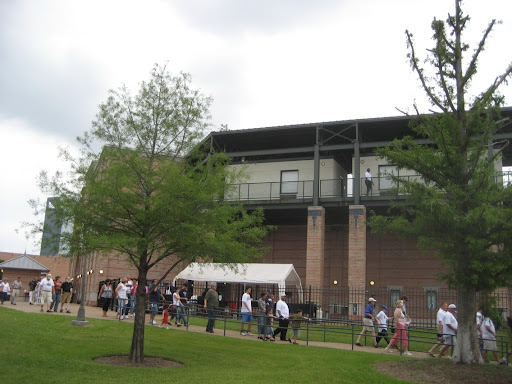
Reckling Park grandstand

As promised, a few more pictures of Reckling Park on the Rice University campus. Today the Owls defeated UCF 8-0, sweeping the Golden Knights in the weekend series. Rice is now 13-2 in conference play and 33-11 overall.


A look at the grandstand from right field.
The main entrance behind home plate, looking out.

Home plate entrance is on the left; this is the exterior down the first-base line.

France's first round: lack of surprise is a surprise

Looks like the polls were more accurate than anyone wanted to admit. With about 64% of votes counted, Nicolas Sarkozy of the UMP has taken over 30%, with Ségolène Royal, the Socialist candidate, taking just under 25%. François Bayrou of the Christian-democratic UDF is around 18% and perennial nationalist candidate Jean-Marie Le Pen has 11%.

Extremely high turnout, probably around 85%, was advantageous to the main candidates. It seems many, many people turned out because they did not want to see a spoiler candidate (i.e., Le Pen) in the second round. And those who voted Le Pen last time as a protest this time either voted for a main candidate or for one of the other candidates. The polls did not hide any Le Pen votes as Sarkozy votes this time around.

What does this mean for the second round? Well, Sarkozy has made a very strong showing. He needs to net some of Bayrou's following while also managing to convince those who voted for Le Pen to come around to him--i.e. appeal to the center and to the right. Royal has a tougher time, as she will probably take the vote going to the smaller leftist candidates, but absolutely needs a strong majority of those who voted for Bayrou. This is possible, if she can continue to frame Sarkozy as too extreme and liberalizing.

All that said, the polls going into today were showing a very narrow (2-4 point) Sarkozy lead in a hypothetical runoff. Still, I give Sarkozy a 60-40 shot at this point.

Oh yeah... how did I do? Well, I accurately stated that the two major candidates would make the runoff, but definitely underestimated their percentages, and overestimated Le Pen. Everyone, including me, was looking for a surprise; but the only surprise was the turnout, not the percentages.