Ken Griffey Jr. has made it to 600. At ESPN, Tim Kurkjian reflects on Griffey in his prime--a prime that we in Seattle had the privilege of watching. Seeing an ESPN clip of Griffey ("the Kid") homering in the Kingdome brought me back to my baseball childhood. I thought I was 13 again! (If you don't feel it, you need to look at this).
It's sad to reflect that Griffey, out of the Mariners' great three (he along with Randy Johnson and Alex Rodriguez), was the only one to really be honest about his intentions--he signed with the Reds, his hometown team, for below market value--and he's been the one to be the most screwed by the situation. While A-Rod got $250m and eventually made his way to New York, and Randy got his rings too (and some Cy Youngs), Griffey just ran into injury and disappointment. He was 30 his first season in Cincinnati (2000) and the best part of his career was over.
The Reds have just one winning season during his time--that first season, 2000--and no playoff appearances. That's certainly partially due to Griffey's injuries. He's reached 500 at-bats only twice in eight full seasons so far. Strangely, he was never seriously injured in Seattle, bar his freak wrist injury on his center-field catch in 1995. Meanwhile, Griffey's seven best seasons in park-adjusted OPS all occurred in Seattle. His best season in Cincinnati (by OPS+ standards), and the eighth-best in his career, was 2003, when he had only 166 at-bats; his best "full" season was 2005, as he managed 491 at-bats, hitting .301/.369/.576 for a 144 OPS+.
That's all there is to this reflection... congratulations to Junior, and may there be many more left.
Showing posts with label baseball. Show all posts
Showing posts with label baseball. Show all posts
Monday, June 09, 2008

Rice Owls head to the College World Series!
As a serious baseball fanatic, living in Houston has been fortunate in one way: I've gotten to follow the Rice Owls, one of the best teams in college ball. I started going to games midway through last season and this season I bought season tickets. Now, you have to understand, in junior high/high school I was one of the youngest active members of SABR (the "saber" in "sabermetrics"), and my old bedroom is still full of my baseball library (probably to my father's chagrin. But where else can I put it?).
This 2008 season has featured a slow start, but the end has definitely made up for it. Last weekend saw Rice go 3-0 in the regional, beating Texas 7-4 on Sunday night in a game that featured a rare ejection (after some truly bad calls by the umpire against Rice).
The super regional this weekend against Texas A&M was two compelling games, in front of excited sellout crowds (about 60 percent of the crowd was probably for A&M). On Saturday night, A&M grabbed an early lead, but Rice came back, with #9 hitter Jordan Dodson--who hit .167 during the regular season, had no at bats in the regional, and went undrafted as a senior--going a stunning 3-for-3 with 4 RBI (this led to "Jordan Dodson" chants all night long on Sunday). Closer Cole St. Clair entered in the fifth, and took Rice the rest of the way, 4 1/3 innings, giving up only two hits and one run, as Rice won 9-6.
On Sunday I managed to bring a camera, so I will throw in some pictures.
 The starting lineups posted on the wall at Reckling Park.
 The lineups are introduced.
 Aggie fans start to pack the left-field hill; they would fill it by the 2nd inning.
A&M again took an early lead in the bottom of the third, scoring two runs off Mike Ojala. (Ojala's most notable moment was probably sticking up his glove in the 3rd inning to catch a quick throw from catcher Adam Zornes... which was actually supposed to go to second base. Ojala knocked the ball off line and the runner was safe.)
In the top of the fourth, the Owls took advantage of a fielding error; freshman shortstop Rick Hague then hit a two-run double and tied up the game. (This would be a good time to mention that this win was thanks to Hague and the relief pitchers, Bryan Price and Bobby Bell; Hague was 3-for-4 with 4 RBI and shone in the field, and the two pitchers went 4 1/3 innings, giving up one hit and no runs).
This led to a near-disastrous bottom of the 4th. Ojala retired only one batter (and that on a sacrifice bunt), leaving with runners on first and third, and a run already in, to make the game 3-2 for A&M. Usual starter Matt Langwell entered, giving up a walk and a double before striking out a hitter, and then giving way to lefty Matt Evers. Evers then walked A&M's cleanup hitter, Luke Anders. This put the bases loaded, with two outs, and three runs already home. Then, a strange call... Kyle Colligan tried to steal home from third base. Catcher Adam Zornes simply tagged him out (see the Chronicle for a picture). A&M did not score after running out of the 4th.
Rice remained down, 5-2, until scoring two in the top of the 6th (again taking advantage of an A&M fielding miscue). With the A&M lead now only one run, the bottom of the 6th was not Diego Seastrunk's finest hour. The Rice 3B was unable to stop a sharp grounder into left for a leadoff single; the next hit bounced off his glove, and while he got it to second for one out, could have been a double play. Rick Hague made a nice play for the inning's second out, but the next batter hit another grounder to Seastrunk, whose throw was offline (for his only official error) and put runners on first and third. Luckily, Hague made another nice play to end the inning and the game remained 5-4.
The top of the 8th was the next big event. Aaron Luna led off with a walk, then was thrown out by a laughable margin trying to steal second. Rick Hague's weak chopper to the left side went for an infield single, but Chad Mozingo flied out, and suddenly there were two outs with a runner on first. Up came catcher Adam Zornes--while he remains the team's home-run leader, his slump had been ongoing since the second part of the regular season. This time, though, Zornes hit a line drive to left field that cleared the fence and gave Rice a 6-5 lead. The Owls would take this lead home, as Price and Bell didn't let A&M threaten.
 Rice players mob Adam Zornes at the plate after his home run put the Owls ahead, 6-5.
 The final scoreboard.
 Rice players celebrate after the Comerota-Hague-Padron double play ends the game.
 Sophomore 2B Jimmy Comerota ("Jimmy Baseball") at the screen after the game.
 One of the game's stars, freshman SS Rick Hague, after the game.
 Coach Wayne Graham (#37) and C Adam Zornes (below him) after the game.
It will be sad to say goodbye to the Rice Owls, so instead I will wish them good luck in Omaha, and I hope I will be back in Houston someday to see them play again!
This 2008 season has featured a slow start, but the end has definitely made up for it. Last weekend saw Rice go 3-0 in the regional, beating Texas 7-4 on Sunday night in a game that featured a rare ejection (after some truly bad calls by the umpire against Rice).
The super regional this weekend against Texas A&M was two compelling games, in front of excited sellout crowds (about 60 percent of the crowd was probably for A&M). On Saturday night, A&M grabbed an early lead, but Rice came back, with #9 hitter Jordan Dodson--who hit .167 during the regular season, had no at bats in the regional, and went undrafted as a senior--going a stunning 3-for-3 with 4 RBI (this led to "Jordan Dodson" chants all night long on Sunday). Closer Cole St. Clair entered in the fifth, and took Rice the rest of the way, 4 1/3 innings, giving up only two hits and one run, as Rice won 9-6.
On Sunday I managed to bring a camera, so I will throw in some pictures.
 The starting lineups posted on the wall at Reckling Park.
 The lineups are introduced.
 Aggie fans start to pack the left-field hill; they would fill it by the 2nd inning.
A&M again took an early lead in the bottom of the third, scoring two runs off Mike Ojala. (Ojala's most notable moment was probably sticking up his glove in the 3rd inning to catch a quick throw from catcher Adam Zornes... which was actually supposed to go to second base. Ojala knocked the ball off line and the runner was safe.)
In the top of the fourth, the Owls took advantage of a fielding error; freshman shortstop Rick Hague then hit a two-run double and tied up the game. (This would be a good time to mention that this win was thanks to Hague and the relief pitchers, Bryan Price and Bobby Bell; Hague was 3-for-4 with 4 RBI and shone in the field, and the two pitchers went 4 1/3 innings, giving up one hit and no runs).
This led to a near-disastrous bottom of the 4th. Ojala retired only one batter (and that on a sacrifice bunt), leaving with runners on first and third, and a run already in, to make the game 3-2 for A&M. Usual starter Matt Langwell entered, giving up a walk and a double before striking out a hitter, and then giving way to lefty Matt Evers. Evers then walked A&M's cleanup hitter, Luke Anders. This put the bases loaded, with two outs, and three runs already home. Then, a strange call... Kyle Colligan tried to steal home from third base. Catcher Adam Zornes simply tagged him out (see the Chronicle for a picture). A&M did not score after running out of the 4th.
Rice remained down, 5-2, until scoring two in the top of the 6th (again taking advantage of an A&M fielding miscue). With the A&M lead now only one run, the bottom of the 6th was not Diego Seastrunk's finest hour. The Rice 3B was unable to stop a sharp grounder into left for a leadoff single; the next hit bounced off his glove, and while he got it to second for one out, could have been a double play. Rick Hague made a nice play for the inning's second out, but the next batter hit another grounder to Seastrunk, whose throw was offline (for his only official error) and put runners on first and third. Luckily, Hague made another nice play to end the inning and the game remained 5-4.
The top of the 8th was the next big event. Aaron Luna led off with a walk, then was thrown out by a laughable margin trying to steal second. Rick Hague's weak chopper to the left side went for an infield single, but Chad Mozingo flied out, and suddenly there were two outs with a runner on first. Up came catcher Adam Zornes--while he remains the team's home-run leader, his slump had been ongoing since the second part of the regular season. This time, though, Zornes hit a line drive to left field that cleared the fence and gave Rice a 6-5 lead. The Owls would take this lead home, as Price and Bell didn't let A&M threaten.
 Rice players mob Adam Zornes at the plate after his home run put the Owls ahead, 6-5.
 The final scoreboard.
 Rice players celebrate after the Comerota-Hague-Padron double play ends the game.
 Sophomore 2B Jimmy Comerota ("Jimmy Baseball") at the screen after the game.
 One of the game's stars, freshman SS Rick Hague, after the game.
 Coach Wayne Graham (#37) and C Adam Zornes (below him) after the game.
It will be sad to say goodbye to the Rice Owls, so instead I will wish them good luck in Omaha, and I hope I will be back in Houston someday to see them play again!
Monday, April 07, 2008
On the Tigers' goose egg
Okay, so the Detroit Tigers are off to an 0-6 start. We've gotten the mandatory barrage of "only two teams have recovered from an 0-6 start to make the postseason." I feel compelled to chime in with my elementary knowledge of statistics...
These first six games are 3.7 percent of the schedule. If the Tigers can go, say, 92-64 the rest of the way, we'll probably see them in the postseason. So, then, why the poor performance by teams that open 0-6? Without any actual numbers, as I'm not the person who will have time to run them, I'd assert that, over the long term, teams have an equal probability of having a losing streak at any point in the season. From that assertion, it follows that teams which are worse have a higher probability of beginning the season with a losing streak, just as they have a higher probability of having a losing streak in any single stretch during the season. If you break it down, I'm "guessing" (or declaring) you'd find that teams with six-game losing streaks to begin the season also have a higher overall rate of losing streaks during the season (which, after all, makes sense, since only two of them have made the playoffs).
ESPN's Jayson Stark points out: "Of the last seven teams that won the World Series, five of them had losing streaks of six games or more at some point that season -- several of them had multiple losing streaks of six games or more." Right, but they probably had fewer losing streaks than everyone else, right?
So, is the Tigers' fate sealed? Clearly not, but they'll have to be a statistical outlier--a good team that just happened to begin the season 0-6.
These first six games are 3.7 percent of the schedule. If the Tigers can go, say, 92-64 the rest of the way, we'll probably see them in the postseason. So, then, why the poor performance by teams that open 0-6? Without any actual numbers, as I'm not the person who will have time to run them, I'd assert that, over the long term, teams have an equal probability of having a losing streak at any point in the season. From that assertion, it follows that teams which are worse have a higher probability of beginning the season with a losing streak, just as they have a higher probability of having a losing streak in any single stretch during the season. If you break it down, I'm "guessing" (or declaring) you'd find that teams with six-game losing streaks to begin the season also have a higher overall rate of losing streaks during the season (which, after all, makes sense, since only two of them have made the playoffs).
ESPN's Jayson Stark points out: "Of the last seven teams that won the World Series, five of them had losing streaks of six games or more at some point that season -- several of them had multiple losing streaks of six games or more." Right, but they probably had fewer losing streaks than everyone else, right?
So, is the Tigers' fate sealed? Clearly not, but they'll have to be a statistical outlier--a good team that just happened to begin the season 0-6.
Sunday, February 24, 2008
It's time for baseball!
I met someone there who was a contributor to Project Scoresheet, the sabermetric project from the early '80s that later evolved into STATS Inc. The project got its impetus from the refusal of baseball's official statistician (Elias) to share specific data. He told me about a conversation he'd had with one of the Astros' announcers at the time. "I was telling him about these numbers," the man said, "and he said to me, 'That's great, but nothing will ever replace the crack of the bat and the smell of the grass.' " And so it is.
Time for baseball once more!
Thursday, January 17, 2008
Selig's contract extended again
A couple days after being called out at Congress, Bud Selig's contract as commissioner has been unanimously extended again (through 2012). In his statements, Selig said: "By the time I leave, you won't recognize the sport." Not sure which is sadder: (1) that Selig thinks not recognizing the sport would be a good thing or that (2) he doesn't realize this is already the case. He's already done quite enough.
Sunday, May 27, 2007
The Continental League debuts
Yet another new independent league--the Continental League--made its debut tonight, including in League City, Texas, where the hometown Bay Area Toros faced the traveling-team Texas Heat. The Continental League is one of eight independent leagues to play this year; together, the leagues total 64 teams, including probably the most famous independent team, the St. Paul Saints of Mike Veeck.
The Bay Area Toros are apparently run by a former Rice assistant athletic director; they play their home games at a high school, Clear Creek HS. (This is a larger high-school ballpark than I'm used to in the Northwest; it seats at least 1,000 in its bleachers, though it has no seat backs.) Overall, they seem like a well-run operation.
Tonight's game was well-attended in relation to the stadium, as there were few empty seats. Notably, the focus was on baseball, not on gimmicks; the crowd seemed into the game, and a large percentage stayed until the end of a game that went 10 innings and took almost four hours. The league president was there and went around meeting fans, and overall the environment was very positive. (The quality of play at a glance seemed around Class A ball).
As would be expected, the park was the only real negative. In addition to the lack of seat backs, the park is oriented towards the northwest, meaning some serious glare. A chain-link fence between the backstop and the field interferes with vision. The only real solution is to succeed at the gate and eventually get a new park (as was already discussed a few days ago in the Chronicle).
I'm quite surprised that the Continental League chose to begin play this year, given that it has only three home markets--two in the DFW market, plus League City (situated between Houston and Galveston). The track record isn't good for leagues that begin without at least a few solid home teams. The Houston area, however, would seem ripe for independent league play; in a market of over 3 million, the Astros are the only game in town once NCAA baseball ends.
I meant to provide pictures, but I forgot my camera, so that will have to wait for the next game... perhaps tomorrow.
[Final note for those in the Northwest: Clear Creek HS was attended by none other than Jay Buhner--"the Bone"! There's a name I hadn't heard in a while...]
Update: Hey, it's me on the Toros homepage! Check out this nice pic...

The Bay Area Toros are apparently run by a former Rice assistant athletic director; they play their home games at a high school, Clear Creek HS. (This is a larger high-school ballpark than I'm used to in the Northwest; it seats at least 1,000 in its bleachers, though it has no seat backs.) Overall, they seem like a well-run operation.
Tonight's game was well-attended in relation to the stadium, as there were few empty seats. Notably, the focus was on baseball, not on gimmicks; the crowd seemed into the game, and a large percentage stayed until the end of a game that went 10 innings and took almost four hours. The league president was there and went around meeting fans, and overall the environment was very positive. (The quality of play at a glance seemed around Class A ball).
As would be expected, the park was the only real negative. In addition to the lack of seat backs, the park is oriented towards the northwest, meaning some serious glare. A chain-link fence between the backstop and the field interferes with vision. The only real solution is to succeed at the gate and eventually get a new park (as was already discussed a few days ago in the Chronicle).
I'm quite surprised that the Continental League chose to begin play this year, given that it has only three home markets--two in the DFW market, plus League City (situated between Houston and Galveston). The track record isn't good for leagues that begin without at least a few solid home teams. The Houston area, however, would seem ripe for independent league play; in a market of over 3 million, the Astros are the only game in town once NCAA baseball ends.
I meant to provide pictures, but I forgot my camera, so that will have to wait for the next game... perhaps tomorrow.
[Final note for those in the Northwest: Clear Creek HS was attended by none other than Jay Buhner--"the Bone"! There's a name I hadn't heard in a while...]
Update: Hey, it's me on the Toros homepage! Check out this nice pic...

Saturday, May 26, 2007
PCL baseball in Reno won't be successful
Looks like there's an agreement to move an unnamed Pacific Coast League team (Tucson? Omaha? New Orleans? Las Vegas?) to Washoe County, aka Reno-Sparks, Nevada. The following are the smallest five PCL markets, plus Reno:
17. Reno, NV, 410,000
16. Des Moines-West Des Moines, IA, 534,000
15. Colorado Springs, CO, 599,000
14. Tacoma, WA, 767,000
13. Albuquerque, NM, 817,000
12. Omaha-Council Bluffs, NE-IA, 823,000
Note the following:
17. Reno, NV, 410,000
16. Des Moines-West Des Moines, IA, 534,000
15. Colorado Springs, CO, 599,000
14. Tacoma, WA, 767,000
13. Albuquerque, NM, 817,000
12. Omaha-Council Bluffs, NE-IA, 823,000
Note the following:
- The Iowa Cubs, with the smallest market in the league, have been quite successfully managed and continue to outdraw their market by the largest ratio. This is an outcome that is by no means guaranteed, and the Midwest is one of the top minor-league regions in the country.
- Colorado Springs and Tacoma are regarded as weak markets.
- Omaha is doing quite poorly.
- Albuquerque, with a renovated stadium and a second chance (after their original Dukes took off), has been supportive--and has almost twice as many people as Reno.
- Nick Lachey is a part-owner of the Tacoma Rainiers (not really relevant, I guess...)
- Reno's independent-league efforts have failed, although the Golden League is giving it another shot this year.
Sunday, April 22, 2007
Reckling Park grandstand
As promised, a few more pictures of Reckling Park on the Rice University campus. Today the Owls defeated UCF 8-0, sweeping the Golden Knights in the weekend series. Rice is now 13-2 in conference play and 33-11 overall.

A look at the grandstand from right field.
 The main entrance behind home plate, looking out.
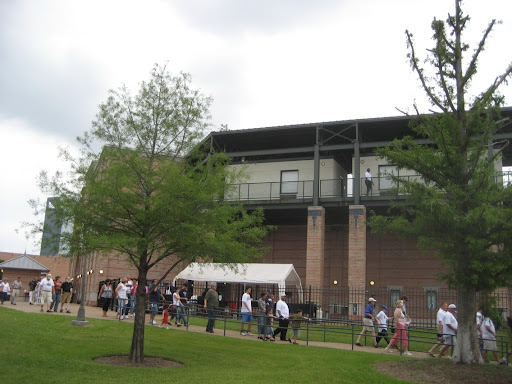 Home plate entrance is on the left; this is the exterior down the first-base line.

A look at the grandstand from right field.
 The main entrance behind home plate, looking out.
 Home plate entrance is on the left; this is the exterior down the first-base line.
Saturday, April 21, 2007
Photos of Reckling Park
It's more expensive to see a game at Rice's Reckling Park--$7 in the bleachers down the lines and $10 in the upper reserved--but the park has more of an atmosphere than UH's Cougar Field. Renovated and reopened in 2000, the park maintains somewhat of an older atmosphere through its brick exterior and concourse building (I'll take photos of that this weekend). However, it is comfortable, has great sightlines and has a nice modern press box behind the stands. I enjoyed the atmosphere--as with many college baseball games, many in the crowd knew each other, and I saw at least four or five other people keeping score near my section!
 Skyline of the Med Center part of Houston.
 Down the home-team side.
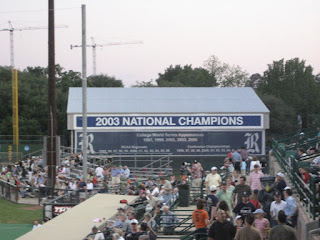 Rice's playoff appearances--the program has been competitive on a consistent basis since the mid-'90s.
 Skyline of the Med Center part of Houston.
 Down the home-team side.
 Rice's playoff appearances--the program has been competitive on a consistent basis since the mid-'90s.
Sunday, April 08, 2007
Shots of Cougar Field
The Houston Cougars played the UAB Blazers this afternoon in the finale of a three-game C-USA series, the Cougars emerging victorious 10-3. The crowd was tiny, due perhaps to (1) Easter, (2) unseasonably chilly weather and (3) a simultaneous Astros game; tickets were $7, perhaps a little more than I'd like to pay but not bad (the red reserved seats lower are $10). Given the paucity of fans, I was able to claim a first-row bleacher seat right behind the plate and keep score, something I hadn't done in a couple of years. (As for the "chilly weather," I thought it was pretty much perfect, but I assume many locals would disagree).
I took the opportunity as well to take a couple photos of Cougar Field, next to Robertson Stadium on Elgin St on the UH campus. It's a nice field and looks just like a comparable lower minor-league park from what I can see. Quite a contrast to Husky Ballpark, which looks temporary (because it is) and is in a beautiful but horribly windy location on Lake Washington...
 A modern scoreboard sits in right field.
 The grandstand with an enclosed press box and a roof on the upper seats.
In the game itself, the Blazers struck in the top of the first, but Houston scored four in the bottom of the first and knocked out the UAB starter. UAB had very little patience at the plate, letting the UH starter out on 5, 9, 16, 9, and 8 pitches in the first five innings. He finished having thrown 76 pitches in 7 innings. Cougar batters showed a good eye and walked seven times, which was key in the victory. The linked article above provides an overall summary.
As I left, fans were already arriving for the bigger sporting event of the night, David Beckham's Galaxy debut against the Houston Dynamo... I will probably be back next weekend, however, as Houston hosts crosstown rival Rice in a three-game series.
I took the opportunity as well to take a couple photos of Cougar Field, next to Robertson Stadium on Elgin St on the UH campus. It's a nice field and looks just like a comparable lower minor-league park from what I can see. Quite a contrast to Husky Ballpark, which looks temporary (because it is) and is in a beautiful but horribly windy location on Lake Washington...
 A modern scoreboard sits in right field.
 The grandstand with an enclosed press box and a roof on the upper seats.
In the game itself, the Blazers struck in the top of the first, but Houston scored four in the bottom of the first and knocked out the UAB starter. UAB had very little patience at the plate, letting the UH starter out on 5, 9, 16, 9, and 8 pitches in the first five innings. He finished having thrown 76 pitches in 7 innings. Cougar batters showed a good eye and walked seven times, which was key in the victory. The linked article above provides an overall summary.
As I left, fans were already arriving for the bigger sporting event of the night, David Beckham's Galaxy debut against the Houston Dynamo... I will probably be back next weekend, however, as Houston hosts crosstown rival Rice in a three-game series.
Wednesday, March 28, 2007
Price discrimination at Dodger Stadium
The L.A. Times reports on price discrimination in baseball:
The Dodgers sell tickets in the field box section for $20, $30, $35, $37, $40 and $45, depending on whether you buy on game day, before game day or as part of a full-season, partial-season or group ticket package.Inevitable as prices climb higher. To put those higher prices in perspective, with some numbers from when I was tiny and not yet aware of baseball,
What's the ticket price? The Dodgers offer you 104 answers in all.
In 1987, the Angels sold tickets for $8, $7, $5 and $3 and the Dodgers for $7, $6 and $4, with every seat on the same level at the same price.Hmm. If I count the Dodger increase as 500 percent ($7 to $35, $6 to $30, $4 to $20), that's 8 percent every year for 20 years. And they wonder why you can't get kids interested in baseball anymore... maybe if they could go to more than one game a year there'd be a better chance.
Subscribe to:
Posts (Atom)

